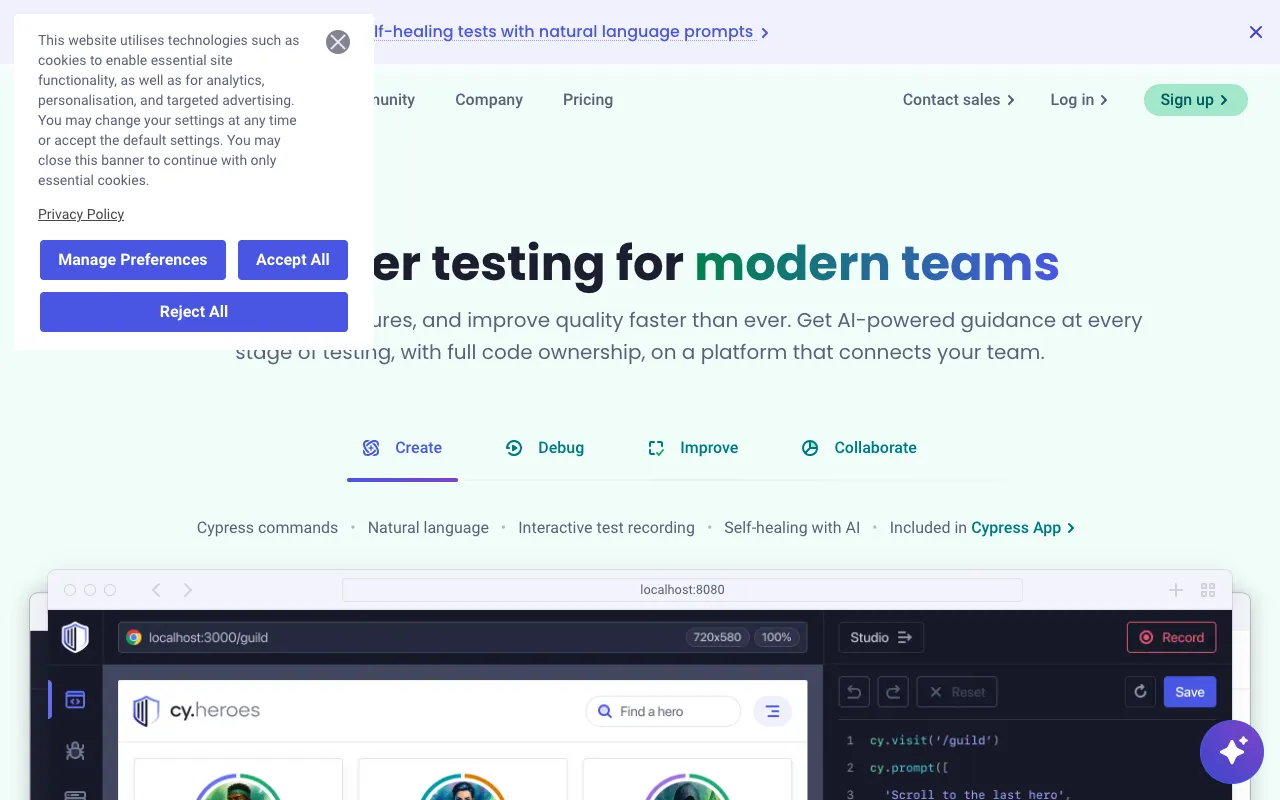
Cypress – The Ultimate End-to-End Testing Tool for Software Engineers
Cypress revolutionizes how developers test web applications. Unlike traditional testing frameworks, Cypress operates directly within the browser, providing native access to every element, network request, and application state. This architecture enables a uniquely rich developer experience with features like real-time reloading, automatic waiting, and time-travel debugging, making it the top choice for engineers who value speed, reliability, and developer productivity in their testing workflow.
What is Cypress?
Cypress is a next-generation, open-source testing framework specifically designed for modern web applications. Its core philosophy centers on providing a complete, all-in-one experience for front-end testing, primarily focusing on end-to-end (E2E) testing but also supporting integration and unit tests. Built from the ground up to address the pain points of Selenium and other older tools, Cypress runs in the same run-loop as your application, giving it unparalleled control and visibility. This allows for more stable, faster, and easier-to-debug tests, fundamentally changing the testing experience for software engineers and QA professionals.
Key Features of Cypress
Time Travel Debugging
Instantly debug your tests with the Cypress Command Log. As your tests run, snapshots are taken at each step. You can hover over commands to see exactly what happened in your application at that moment, making it trivial to identify why a test failed without sifting through logs or screenshots.
Automatic Waiting
Forget about adding manual waits or sleep commands to your tests. Cypress automatically waits for commands and assertions before moving on. It intelligently waits for elements to become visible, animations to complete, and network requests to finish, eliminating one of the most common sources of flaky tests.
Real-Time Reloads
Cypress provides a real-time, interactive Test Runner. As you write and save your test files, Cypress immediately re-runs the relevant tests. This tight feedback loop mirrors the experience of modern front-end development, allowing for rapid test-driven development (TDD) and immediate validation of code changes.
Network Traffic Control
Stub and intercept network requests at will. Cypress gives you complete control over your application's XHR and Fetch requests. You can test edge cases, simulate slow networks, or test application behavior without relying on a back-end server, leading to faster and more deterministic tests.
Consistent Results
Cypress is architected to provide consistent, non-flaky test results. Because it doesn't use WebDriver, it avoids the inherent latency and synchronization issues of traditional tools. Tests run consistently in CI/CD pipelines just as they do on a local machine, building trust in your automated test suite.
Who Should Use Cypress?
Cypress is the ideal testing solution for front-end developers, full-stack engineers, and QA automation specialists working on modern JavaScript web applications (built with React, Vue, Angular, etc.). It's perfect for teams practicing Agile or CI/CD who need fast, reliable feedback on their code changes. Developers who are frustrated with the brittleness and slow feedback loops of Selenium-based frameworks will find Cypress to be a transformative upgrade. It's also highly beneficial for teams implementing Test-Driven Development (TDD) for front-end features due to its real-time reloading and excellent debugging capabilities.
Cypress Pricing and Free Tier
Cypress offers a powerful, fully-featured open-source core that is completely free for individual use and small teams. This free tier includes the Test Runner, Dashboard service (for a limited number of test results per month), and all core testing capabilities. For enterprise needs, Cypress provides paid Cloud and Business plans. These add advanced features like intelligent test orchestration, parallelization, analytics, and enhanced security controls, designed for scaling test suites across large organizations and complex CI/CD environments.
Common Use Cases
- Testing user authentication flows and form submissions in a React application
- Validating complex single-page application (SPA) state and routing behavior
- Automating cross-browser visual regression testing for UI components
Key Benefits
- Dramatically reduces time spent writing, debugging, and maintaining flaky end-to-end tests
- Enables faster release cycles by providing a reliable safety net for front-end changes
- Improves code quality and developer confidence through a superior testing feedback loop
Pros & Cons
Pros
- Unmatched developer experience with time-travel debugging and real-time feedback
- Eliminates flaky tests with automatic waiting and a non-WebDriver architecture
- Comprehensive documentation and a large, active community for support
- Seamless integration with popular CI/CD tools and JavaScript frameworks
Cons
- Primarily designed for testing in Chromium-based browsers (Chrome, Edge, Electron)
- Cannot drive two browsers at once for testing multi-user interactions
- The learning curve for its unique architecture and API differs from Selenium
Frequently Asked Questions
Is Cypress free to use?
Yes, Cypress has a robust and fully-featured open-source core that is completely free for individual developers and teams. This includes the local Test Runner and a basic tier of the Dashboard service. Paid plans (Cloud/Business) are available for teams requiring advanced orchestration, parallelization, and enterprise security features.
Is Cypress good for end-to-end testing?
Cypress is considered one of the best tools available for end-to-end testing of modern web applications. Its architecture, which runs in the same loop as your app, provides native access and control, leading to faster, more reliable, and easier-to-debug tests compared to traditional Selenium-based frameworks. It's specifically optimized for the E2E testing workflow.
Can Cypress test mobile applications?
Cypress is designed for testing web applications that run in a browser. It can be used to test the web view of hybrid mobile apps or to test responsive web designs by simulating various viewport sizes. However, it is not a tool for testing native mobile applications (iOS/Android); for that, you would need a framework like Appium.
How does Cypress compare to Selenium?
Cypress offers a fundamentally different and more modern approach than Selenium. While Selenium is a remote control protocol that works across many languages and browsers, Cypress is a JavaScript-native framework that runs in the browser with your app. This gives Cypress advantages in speed, stability (no flaky waits), and developer experience (real-time reloads, time travel). Selenium remains a broader standard for cross-browser automation where driving multiple browsers simultaneously is required.
Conclusion
For software engineers prioritizing a fast, reliable, and enjoyable testing workflow, Cypress stands out as the definitive tool for front-end and end-to-end testing. Its developer-centric design—featuring time-travel debugging, automatic waiting, and real-time feedback—transforms testing from a chore into an integrated part of the development process. While it has specific limitations, such as browser support, its overwhelming benefits in productivity and test reliability make it the top recommendation for teams building modern JavaScript applications. Whether you're an individual developer or part of a large engineering organization, starting with Cypress's free tier is the most effective way to elevate your testing strategy.