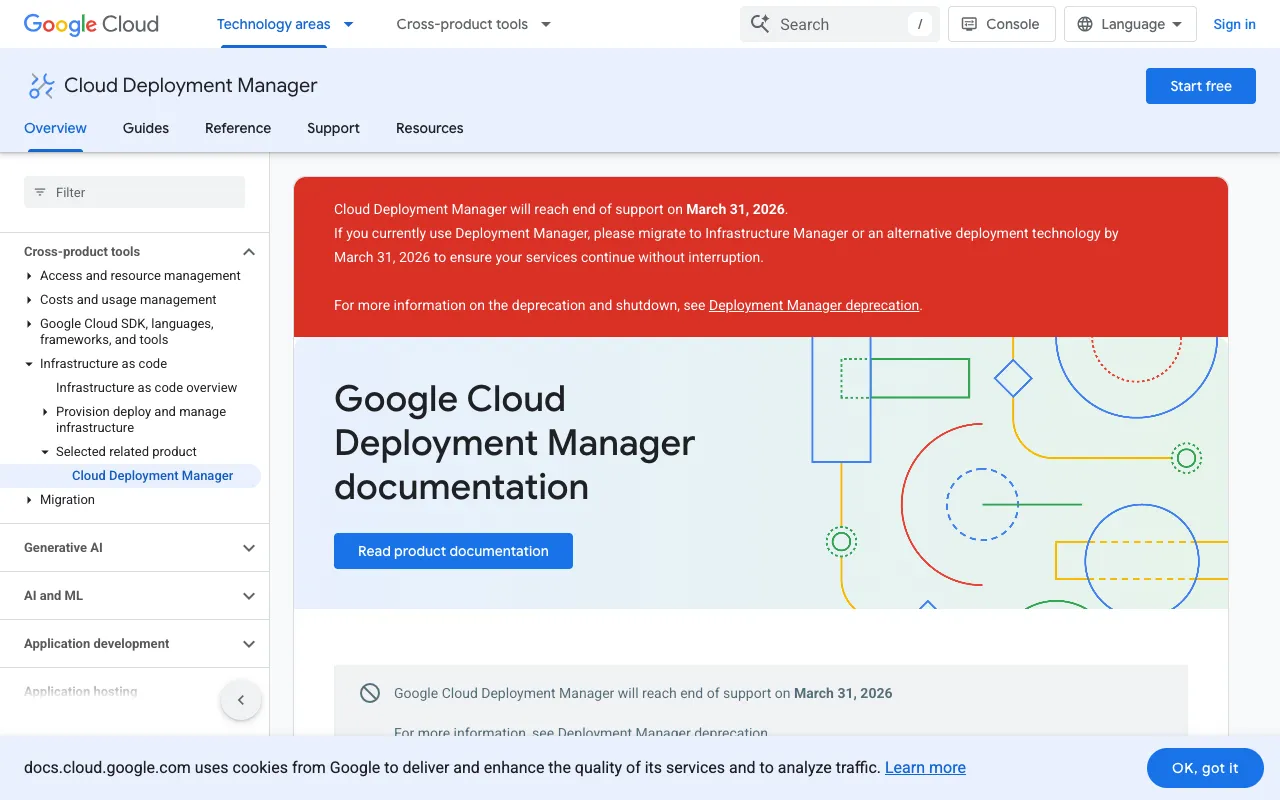
Google Cloud Deployment Manager – Best Infrastructure Deployment Tool for DevOps
Google Cloud Deployment Manager is a powerful infrastructure as code service designed specifically for Google Cloud Platform. It enables DevOps engineers, SREs, and cloud architects to define, deploy, and manage complex GCP resources through declarative configuration files. By treating infrastructure as code, teams can achieve consistency, repeatability, and version control for their cloud environments, significantly reducing manual errors and deployment time.
What is Google Cloud Deployment Manager?
Google Cloud Deployment Manager is Google Cloud's native infrastructure orchestration service. It allows you to specify all the resources needed for your application—such as Compute Engine VMs, Cloud Storage buckets, VPC networks, and Cloud SQL instances—in a declarative YAML or Jinja2/Python template. You describe what your final cloud environment should look like, and Deployment Manager handles the provisioning, dependencies, and configuration. This service is fundamental for implementing GitOps practices, continuous deployment pipelines, and managing infrastructure lifecycles on GCP.
Key Features of Google Cloud Deployment Manager
Declarative Template-Based Deployment
Define your entire infrastructure stack using YAML configuration files. This declarative approach means you specify the desired end state, and Deployment Manager determines the execution plan to create, update, or delete resources to match that state, ensuring idempotent deployments.
Template Language Flexibility
Go beyond static YAML with support for Jinja2 and Python templates. This allows for parameterization, loops, conditionals, and modular designs, enabling you to create reusable, dynamic infrastructure blueprints for different environments (dev, staging, prod).
Resource Dependency Management
Deployment Manager automatically understands and manages dependencies between GCP resources. It creates resources in the correct order (e.g., a network before a subnet, a subnet before a VM) and can roll back changes if a deployment fails, helping to maintain a consistent state.
Integrated GCP Experience
As a native GCP service, it offers deep integration with Cloud IAM for security, Cloud Monitoring for observability, and Cloud Audit Logs. Updates and operations are performed directly through the Google Cloud Console, gcloud CLI, or a well-documented REST API.
Who Should Use Google Cloud Deployment Manager?
This tool is ideal for DevOps engineers, Site Reliability Engineers (SREs), and cloud platform teams committed to Google Cloud Platform. It's perfect for organizations practicing Infrastructure as Code (IaC), implementing CI/CD for infrastructure, and needing to manage standardized, repeatable environments across projects. Teams looking to enforce compliance and security policies through code will find its template-driven approach invaluable.
Google Cloud Deployment Manager Pricing and Free Tier
Google Cloud Deployment Manager itself is offered at no additional cost. You only pay for the underlying Google Cloud Platform resources (VMs, storage, databases, etc.) that you provision and manage through it. This makes it a cost-effective choice for infrastructure automation, as there is no licensing fee for the orchestration service. All standard GCP free tier offers and credits apply to the resources you create.
Common Use Cases
- Automating the deployment of a multi-tier web application on Google Kubernetes Engine and Cloud SQL
- Creating consistent development and testing environments on Google Cloud Platform using parameterized templates
Key Benefits
- Eliminates manual infrastructure provisioning, reducing human error and deployment time from hours to minutes
- Provides a single source of truth for your GCP infrastructure, enabling version control, peer review, and rollback capabilities
Pros & Cons
Pros
- Native GCP integration ensures optimal performance and access to the latest services
- No additional cost for the orchestration layer, only pay for provisioned resources
- Declarative and template-driven approach enforces consistency and supports GitOps workflows
Cons
- Vendor-locked to Google Cloud Platform and cannot manage resources on AWS or Azure
- Learning curve associated with mastering its template syntax and resource types
Frequently Asked Questions
Is Google Cloud Deployment Manager free to use?
Yes, the Google Cloud Deployment Manager service itself is free. You are only billed for the Google Cloud Platform resources (like Compute Engine VMs, Cloud Storage, etc.) that you create and manage using the service. The GCP Free Tier may apply to eligible resources.
Is Google Cloud Deployment Manager a good tool for DevOps?
Absolutely. For DevOps teams on Google Cloud Platform, it is a core Infrastructure as Code (IaC) tool. It enables automated, repeatable, and version-controlled infrastructure deployments, which are essential principles of modern DevOps and SRE practices for achieving reliability and velocity.
How does Google Cloud Deployment Manager compare to Terraform?
Both are IaC tools, but Deployment Manager is a GCP-native service with deep, first-party integration. Terraform by HashiCorp is multi-cloud. Deployment Manager is ideal for teams fully committed to GCP who want a tightly integrated, no-extra-cost solution. Terraform is better for multi-cloud or hybrid environments.
Conclusion
For DevOps teams building their future on Google Cloud Platform, Google Cloud Deployment Manager is an essential, native tool for infrastructure automation. Its declarative, template-based approach provides the control and consistency required for modern cloud operations. While it is specific to GCP, its seamless integration, robust dependency management, and lack of additional licensing fees make it a top-tier choice for automating and governing your cloud environment. If your stack is on Google Cloud, mastering Deployment Manager is a strategic investment in your infrastructure's reliability and scalability.