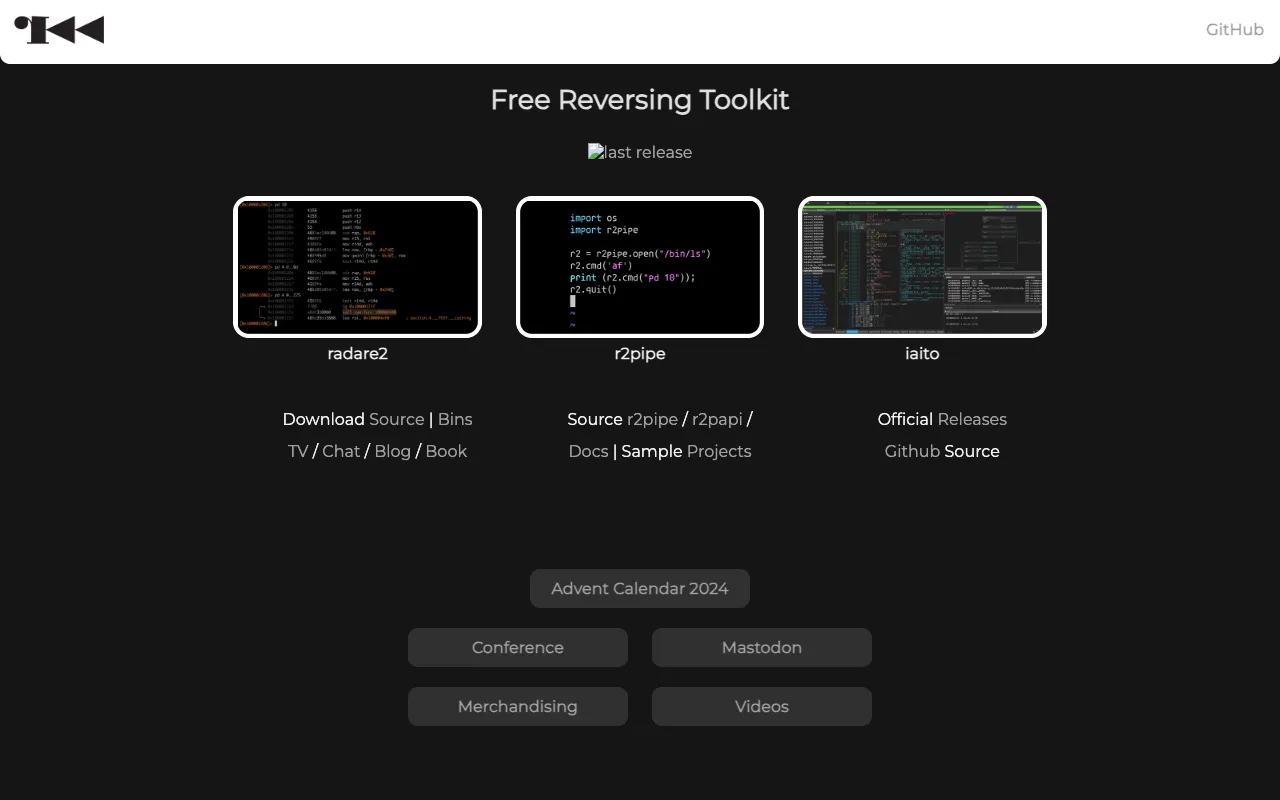
Radare2 – The Essential Free Reverse Engineering Framework for Cybersecurity
Radare2 (r2) is the premier open-source reverse engineering and binary analysis framework trusted by cybersecurity professionals worldwide. Unlike expensive commercial tools, Radare2 offers a complete, scriptable, and portable command-line toolkit for dissecting executables, analyzing malware, debugging processes, and performing forensic investigations. Its modular design and extensibility make it an indispensable asset for penetration testers, malware researchers, and security analysts seeking deep visibility into software at the binary level.
What is Radare2?
Radare2 is a comprehensive, free, and open-source reverse engineering framework. It functions as a suite of command-line utilities that work in concert to provide capabilities for disassembling binaries, debugging running processes, analyzing file formats, patching code, and performing forensic data carving. Built with a 'Unix philosophy' of small, composable tools, it offers unparalleled flexibility and power directly from your terminal, making it a staple in the toolkits of advanced security researchers and incident responders.
Key Features of Radare2
Advanced Disassembler and Debugger
Radare2 features a robust disassembler supporting a vast array of architectures (x86/x64, ARM, MIPS, etc.) and a full-featured debugger for Linux, Windows, macOS, and Android. You can statically analyze binaries or attach to live processes for dynamic analysis, setting breakpoints, inspecting memory, and tracing execution flow.
Scriptable Automation and Extensibility
Automate complex reverse engineering tasks using r2's own scripting language (r2pipe) or via bindings in Python, JavaScript, Go, and more. This allows for batch analysis, custom tool creation, and integration into larger security workflows and CI/CD pipelines for vulnerability research.
Forensic and Binary Analysis Capabilities
Beyond disassembly, Radare2 excels at binary forensics. It can analyze file formats, extract embedded data, identify cryptographic constants, visualize control flow graphs, and perform entropy analysis—all crucial for malware analysis and vulnerability discovery.
Unified Workflow for Multiple Tasks
Radare2 consolidates numerous reverse engineering tasks into a single framework. Switch seamlessly between hex editing, disassembly, debugging, and scripting without leaving the r2 environment, creating a highly efficient and cohesive analysis workflow.
Who Should Use Radare2?
Radare2 is designed for technical cybersecurity professionals who require deep, low-level analysis capabilities. Its primary users include Malware Analysts dissecting advanced persistent threats (APTs), Vulnerability Researchers hunting for 0-day exploits, Incident Responders performing forensic analysis on compromised systems, Red Teamers writing custom exploits, and Security Engineers building automated analysis pipelines. While it has a learning curve, it is the tool of choice for experts who need maximum power and control without licensing costs.
Radare2 Pricing and Free Tier
Radare2 is completely free and open-source software released under the GNU LGPL license. There is no paid tier, subscription, or enterprise version—all features are available to everyone at zero cost. This commitment to accessibility makes professional-grade reverse engineering tools available to individual researchers, academic institutions, and organizations of all sizes, fostering a strong global community of contributors and users.
Common Use Cases
- Analyzing and reverse engineering sophisticated malware samples for threat intelligence
- Conducting vulnerability research and exploit development on proprietary software
- Performing forensic analysis on suspicious binaries during a security incident response
- Automating the extraction of Indicators of Compromise (IOCs) from malware families
Key Benefits
- Gain complete, vendor-independent control over the binary analysis process without licensing restrictions.
- Automate repetitive analysis tasks to scale vulnerability discovery and malware research efforts.
- Access a powerful, portable toolkit that runs anywhere, ideal for field forensics and embedded system analysis.
- Leverage community-driven development for continuous updates and support for new architectures and file formats.
Pros & Cons
Pros
- Completely free and open-source with no feature limitations.
- Extremely powerful and scriptable, enabling complex automated analysis.
- Supports a wide range of CPU architectures, OS platforms, and file formats.
- Active community and continuous development by security experts.
Cons
- Steep learning curve with a command-line interface that can be intimidating for beginners.
- Documentation can be dense and assumes a high level of existing knowledge.
- Lacks the polished graphical user interface (GUI) of some commercial alternatives.
Frequently Asked Questions
Is Radare2 free to use?
Yes, Radare2 is 100% free and open-source software. There are no costs, licenses, or paid tiers. All features, including disassembly, debugging, and scripting, are available completely free of charge.
Is Radare2 good for malware analysis?
Absolutely. Radare2 is one of the most powerful tools available for malware analysis. Its capabilities for static disassembly, dynamic debugging, scripting for automation, and forensic analysis make it ideal for dissecting complex malware, understanding its behavior, and extracting key indicators for threat hunting.
How does Radare2 compare to IDA Pro or Ghidra?
Radare2 is a powerful, free alternative to IDA Pro. While IDA may have a more mature GUI, Radare2 offers comparable deep analysis power from the command line, superior scripting flexibility, and is completely free. Compared to Ghidra (also free), Radare2 is more lightweight, scriptable via multiple languages, and offers a unified workflow for both static and dynamic analysis within a single tool.
What is the best way to learn Radare2 for cybersecurity?
The best approach is to start with the official 'r2book' and practical exercises on crackmes. Begin with basic commands for file analysis and disassembly, then progress to scripting simple tasks. Engaging with the active community on GitHub and dedicated forums is invaluable for overcoming challenges and learning advanced techniques used in real-world security research.
Conclusion
For cybersecurity professionals who demand uncompromising power, flexibility, and control in their reverse engineering work, Radare2 stands as an essential, industry-respected framework. Its completely free and open-source nature removes all financial barriers to entry, while its extensive feature set and scriptability rival even the most expensive commercial tools. While mastering its command-line interface requires dedication, the payoff is a deeply customizable analysis environment capable of tackling the most sophisticated malware, firmware, and software targets. For serious vulnerability research, malware analysis, and binary forensics, Radare2 is not just a tool—it's a foundational platform for advanced security work.