web3.js – The Essential JavaScript Library for Ethereum Blockchain Developers
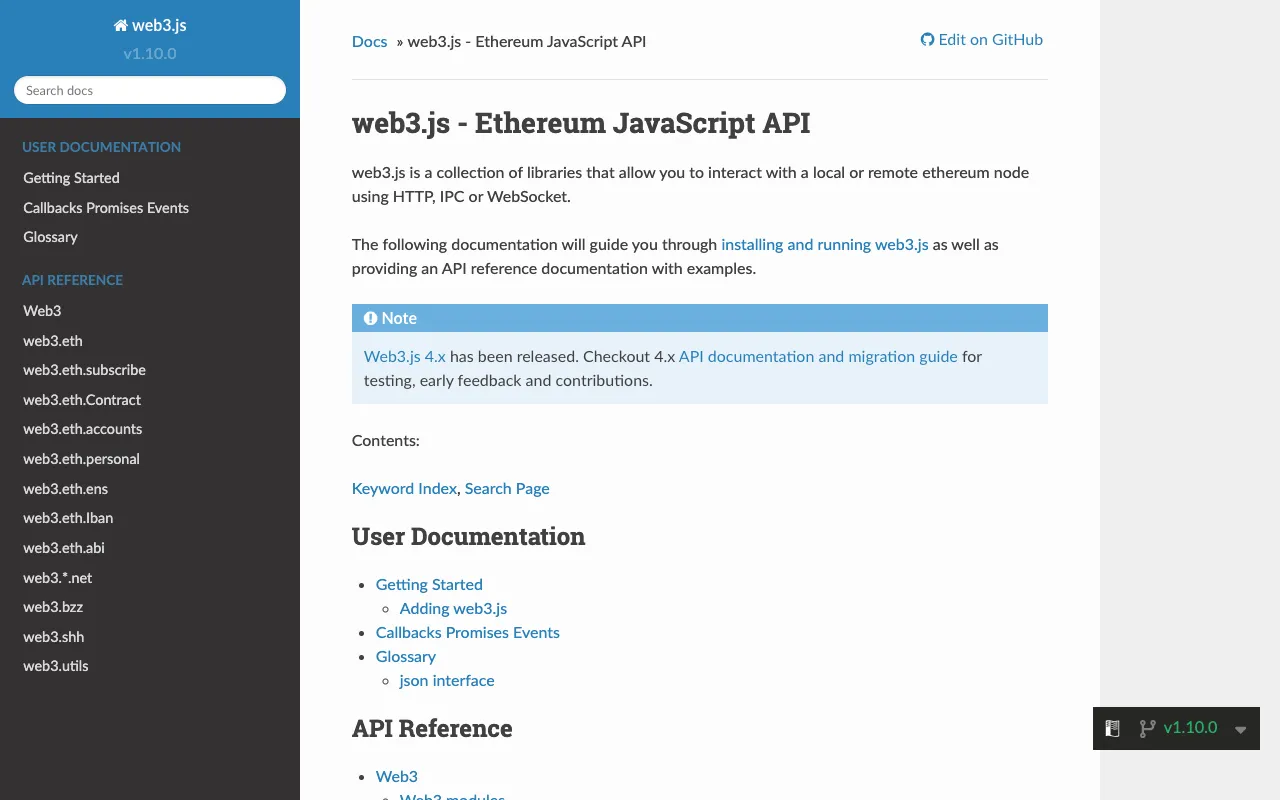
web3.js is the cornerstone JavaScript library for Ethereum development, enabling developers to seamlessly connect their applications to the Ethereum blockchain. Whether you're building a decentralized application (DApp), a DeFi protocol, an NFT marketplace, or any Web3 solution, web3.js provides the essential APIs to interact with local or remote Ethereum nodes via HTTP, IPC, or WebSocket. It abstracts the complexity of direct JSON-RPC calls, offering a clean, promise-based interface to send transactions, call smart contract functions, listen to events, and query blockchain state, making it the first-choice tool for JavaScript developers entering the Web3 space.
What is web3.js?
web3.js is an open-source JavaScript library that serves as the primary gateway for JavaScript applications to communicate with the Ethereum network. It acts as a bridge between your frontend or backend code and an Ethereum node (like Geth, Infura, or Alchemy), translating high-level JavaScript commands into the JSON-RPC calls that the node understands. Its core purpose is to simplify blockchain interaction, allowing developers to focus on application logic rather than low-level protocol details. It's designed for developers of all levels, from those building their first smart contract frontend to teams architecting complex decentralized finance systems.
Key Features of web3.js
Multi-Transport Node Connection
Establish robust connections to Ethereum nodes using the most suitable protocol. Connect via HTTP for standard web requests, WebSocket for real-time, persistent subscriptions to events and blocks, or IPC for secure, high-performance communication with a local node. This flexibility ensures your DApp works reliably in any deployment environment, from browser extensions to server-side applications.
Smart Contract Interaction Abstraction
Dramatically simplify working with Ethereum smart contracts. web3.js can automatically generate a JavaScript contract object from a Solidity ABI (Application Binary Interface). This allows you to call contract methods as if they were local JavaScript functions, seamlessly handling encoding, sending transactions, and decoding return values, which accelerates development and reduces errors.
Comprehensive Ethereum API Coverage
Access the full spectrum of Ethereum functionality. The library provides modules for core Ethereum namespaces: `eth` for blockchain interaction (accounts, transactions, blocks), `net` for network properties, `personal` for account management (deprecated in newer versions), and `utils` for essential cryptographic helpers and data formatting, giving you complete control over blockchain operations.
Event Listening and Subscription
Build reactive applications that respond instantly to on-chain activity. web3.js enables you to subscribe to specific smart contract events or log filters. Your application can listen for transactions, token transfers, or custom contract events in real-time, which is critical for features like live notifications, updating UI state, or triggering backend processes.
Who Should Use web3.js?
web3.js is indispensable for any developer or team building on Ethereum. Frontend JavaScript/TypeScript developers use it to create DApp user interfaces that interact with MetaMask and smart contracts. Full-stack and backend Node.js developers leverage it for server-side blockchain indexing, transaction processing, and automation bots. It's also a fundamental tool for DevOps engineers scripting blockchain interactions and for educators teaching Web3 development concepts. If your project involves reading data from or writing data to the Ethereum blockchain, web3.js is likely a core dependency.
web3.js Pricing and Free Tier
web3.js is a 100% open-source library released under the LGPL-3.0 license. There are no fees, subscriptions, or paid tiers to use the library itself. It is completely free to install, use, and modify. The only potential costs in a project are related to the Ethereum node infrastructure you connect to (e.g., using a paid tier of a node provider like Infura for higher request rates), but the web3.js library incurs no cost.
Common Use Cases
- Building a frontend for an Ethereum decentralized application (DApp) that interacts with user wallets
- Creating a Node.js backend service to monitor smart contract events and update a database
- Developing a bot to automate DeFi yield farming strategies or arbitrage opportunities
- Scripting the deployment and configuration of smart contracts for a project
Key Benefits
- Accelerate Web3 development by providing a standardized, well-documented interface for all Ethereum interactions.
- Reduce development errors with built-in data type validation, encoding/decoding, and error handling specific to blockchain operations.
- Future-proof your application with strong community support, regular updates for new Ethereum hard forks, and a vast ecosystem of plugins and extensions.
Pros & Cons
Pros
- Industry Standard: The most widely used and trusted JS library for Ethereum, ensuring vast community support and resources.
- Full-Featured: Offers a complete API covering every interaction needed with the Ethereum blockchain.
- Active Development: Maintained by the Ethereum Foundation and community, with frequent updates and good documentation.
- Flexible: Works in browser environments and Node.js, connecting to any standard Ethereum node.
Cons
- Bundle Size: The full library can be large for frontend applications, though tree-shaking and using specific sub-packages can help.
- Learning Curve: Understanding Ethereum concepts (gas, nonces, events) is prerequisite to using the library effectively.
- Version Differences: Breaking changes between major versions (e.g., 0.x.x to 1.x.x) require migration effort for existing projects.
Frequently Asked Questions
Is web3.js free to use?
Yes, absolutely. web3.js is a free, open-source library. You can install it via npm (`npm install web3`) or include it via a CDN at no cost. There are no licensing fees or paid features within the library itself.
Is web3.js good for blockchain developers?
web3.js is not just good—it's essential for Ethereum blockchain developers using JavaScript. It is the foundational tool that enables communication between your code and the Ethereum network. For developers building DApps, DeFi protocols, NFT projects, or any on-chain application, proficiency in web3.js is a core required skill.
What's the difference between web3.js and Ethers.js?
Both are excellent JavaScript libraries for Ethereum. web3.js is the original official library, offering a comprehensive, slightly lower-level API that closely mirrors Ethereum's JSON-RPC. Ethers.js is a newer, popular alternative known for its smaller bundle size, cleaner wallet abstraction, and more modular design. The choice often comes down to project requirements and developer preference, but web3.js remains a powerhouse with unparalleled ecosystem integration.
Do I need to run my own Ethereum node to use web3.js?
No, you do not need to run your own node. While you can connect web3.js to a local node (like Geth) for maximum control, most developers connect to remote node providers such as Infura, Alchemy, or QuickNode. These services provide the node infrastructure, allowing you to focus on building your application. web3.js connects seamlessly to these provider endpoints.
Conclusion
For any JavaScript developer building on Ethereum, web3.js is the indispensable workhorse. Its comprehensive API, proven reliability, and deep integration with the Ethereum ecosystem make it the most authoritative tool for blockchain interaction. While alternatives exist, web3.js offers the most complete and battle-tested solution for projects ranging from simple smart contract frontends to complex enterprise-grade DeFi systems. Mastering web3.js is a fundamental step in becoming a proficient Web3 developer.