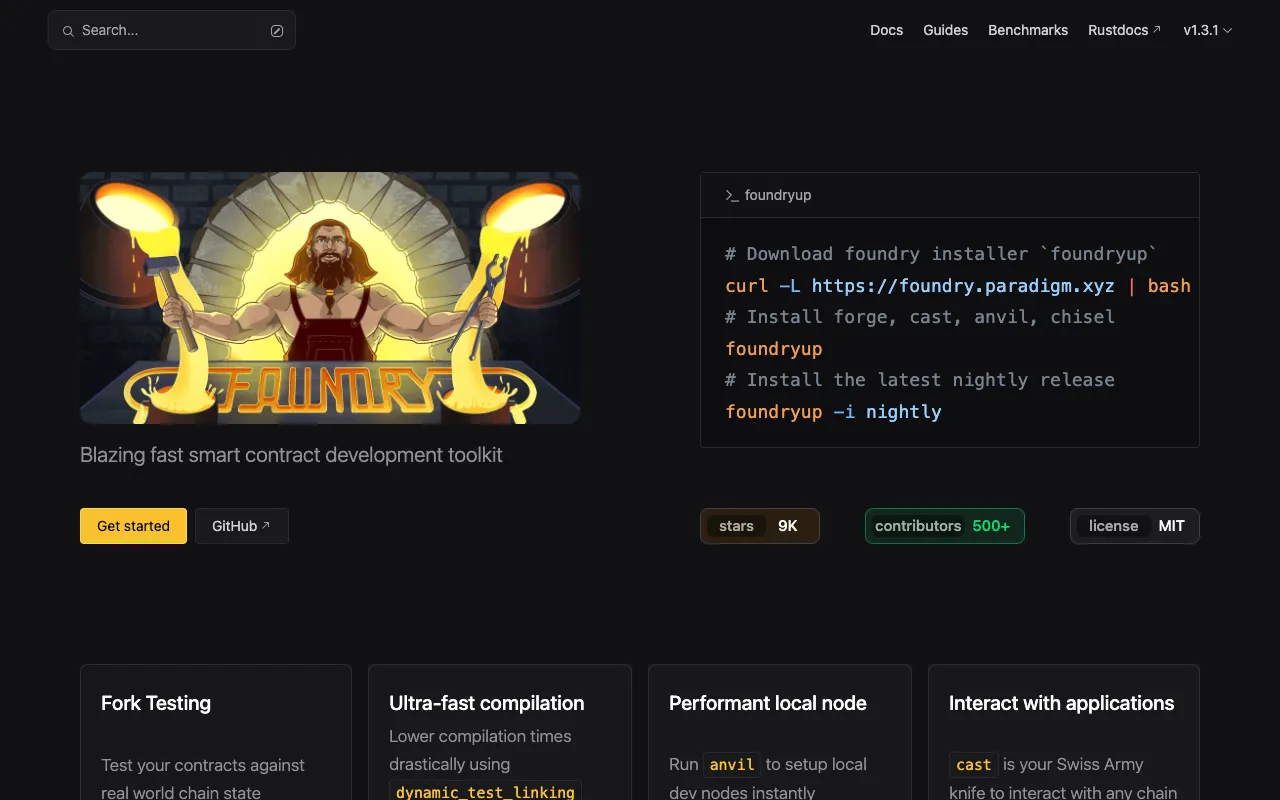
Foundry – Best Ethereum Development Toolkit for Blockchain Developers
Foundry is revolutionizing Ethereum smart contract development with a high-performance, Rust-based toolkit designed for the modern blockchain engineer. It consolidates essential workflows—testing, deployment, and local development—into a single, portable suite featuring Forge, Cast, and Anvil. Built for speed and developer experience, Foundry eliminates environment inconsistencies and accelerates the development cycle from prototype to production, making it the top choice for developers prioritizing efficiency and reliability.
What is Foundry?
Foundry is a comprehensive, open-source development toolkit specifically engineered for the Ethereum ecosystem. Written in Rust for exceptional performance, it provides a unified environment for the entire smart contract lifecycle. Its core philosophy centers on speed, portability, and a modular design that empowers developers. Unlike traditional JavaScript/TypeScript-based toolchains, Foundry allows you to write tests in Solidity itself, fostering a deeper, more intuitive development process. It's the essential toolkit for developers and teams building secure, high-performance decentralized applications (dApps), DeFi protocols, and NFTs.
Key Features of Foundry
Forge: Solidity-Native Testing Framework
Forge is Foundry's flagship testing and deployment framework. Its standout feature is enabling developers to write unit and integration tests directly in Solidity, using the same language as their contracts. This eliminates context switching and provides faster execution with fuzz testing, invariant testing, and gas snapshotting built-in. Forge's speed is unmatched, executing test suites significantly faster than alternatives, which dramatically improves developer productivity and CI/CD pipeline efficiency.
Cast: Swiss Army Knife for EVM Interactions
Cast is a powerful command-line tool for directly interacting with Ethereum and other EVM-compatible blockchains. It allows developers to send transactions, read contract state, decode calldata, query wallet balances, and simulate calls without writing custom scripts. Cast simplifies common blockchain operations, making it indispensable for deployment scripts, on-chain data analysis, and smart contract debugging from the terminal.
Anvil: Local Ethereum Node for Development
Anvil is a local Ethereum node implementation, akin to Ganache or Hardhat Network, but built for speed. It allows developers to fork mainnet state for realistic testing, mine blocks instantly, and impersonate accounts for complex transaction simulations. Anvil's performance and deep integration with Forge and Cast create a seamless local development environment, enabling rapid iteration and testing of complex contract interactions.
Who Should Use Foundry?
Foundry is ideal for Ethereum smart contract developers, security auditors, and DevOps engineers who value performance and a streamlined workflow. It's particularly beneficial for: Solidity developers tired of slow test runners; DeFi protocol teams requiring fast, reliable testing for complex financial logic; security researchers conducting deep contract analysis and fuzzing; and developers who prefer a CLI-centric, scriptable toolchain that integrates easily into automated pipelines. If your priority is building robust, well-tested contracts with maximum efficiency, Foundry is for you.
Foundry Pricing and Free Tier
Foundry is completely free and open-source software (FOSS), released under the permissive Apache/MIT licenses. There is no premium tier, enterprise license, or hidden cost. The entire toolkit—including Forge, Cast, and Anvil—can be installed and used for personal projects, commercial applications, and enterprise-scale development at zero cost. This commitment to open access has made it a cornerstone of the Ethereum development ecosystem.
Common Use Cases
- Writing and executing high-speed unit tests for Solidity smart contracts
- Forking the Ethereum mainnet to test DeFi integrations with real-world state
- Automating deployment scripts and on-chain interactions from the command line
- Conducting security audits with advanced fuzzing and invariant testing
Key Benefits
- Dramatically faster test execution reduces development cycle time and CI costs
- Write tests in Solidity for a unified, context-free development experience
- Portable, single-binary installation eliminates "works on my machine" issues
- Free and open-source tooling with no vendor lock-in or usage limits
Pros & Cons
Pros
- Blazing fast test execution powered by Rust
- Native Solidity testing eliminates JavaScript/TypeScript dependency
- Integrated, modular toolkit (Forge, Cast, Anvil) covers the full dev lifecycle
- Completely free and open-source with a vibrant community
Cons
- Steeper initial learning curve compared to JavaScript-based frameworks
- Ecosystem of plugins and integrations is younger than more established tools
- Primarily CLI-focused, with less built-in GUI tooling
Frequently Asked Questions
Is Foundry free to use?
Yes, Foundry is 100% free and open-source. The entire toolkit, including Forge, Cast, and Anvil, is available under permissive licenses for any use case—personal, commercial, or enterprise—with no fees or restrictions.
Is Foundry good for Ethereum smart contract development?
Absolutely. Foundry is widely regarded as one of the best toolkits for Ethereum development. Its speed, Solidity-native testing with Forge, and comprehensive CLI tools make it exceptionally efficient for building, testing, and deploying secure smart contracts.
How does Foundry compare to Hardhat?
Foundry is often chosen for its raw speed (Rust vs. JS) and Solidity-based testing, offering a more integrated experience for developers who live in Solidity. Hardhat, built on Node.js, has a larger plugin ecosystem and may feel more familiar to JavaScript developers. Many professional teams use both, selecting the best tool for specific tasks.
Can I use Foundry with other EVM chains?
Yes. Foundry works seamlessly with any Ethereum Virtual Machine (EVM) compatible blockchain, including Polygon, Arbitrum, Optimism, Avalanche C-Chain, and Binance Smart Chain. You can configure RPC endpoints and chain parameters for development and deployment on these networks.
Conclusion
For blockchain developers seeking a fast, reliable, and integrated toolkit, Foundry represents the current pinnacle of Ethereum development tooling. Its combination of Forge's testing prowess, Cast's interaction capabilities, and Anvil's local node provides a complete environment that accelerates development without sacrificing power or control. While it demands a shift in mindset from JavaScript-based toolchains, the payoff in performance, workflow cohesion, and cost (free!) is substantial. For building the next generation of high-assurance decentralized applications on Ethereum, Foundry is an indispensable and top-tier choice.