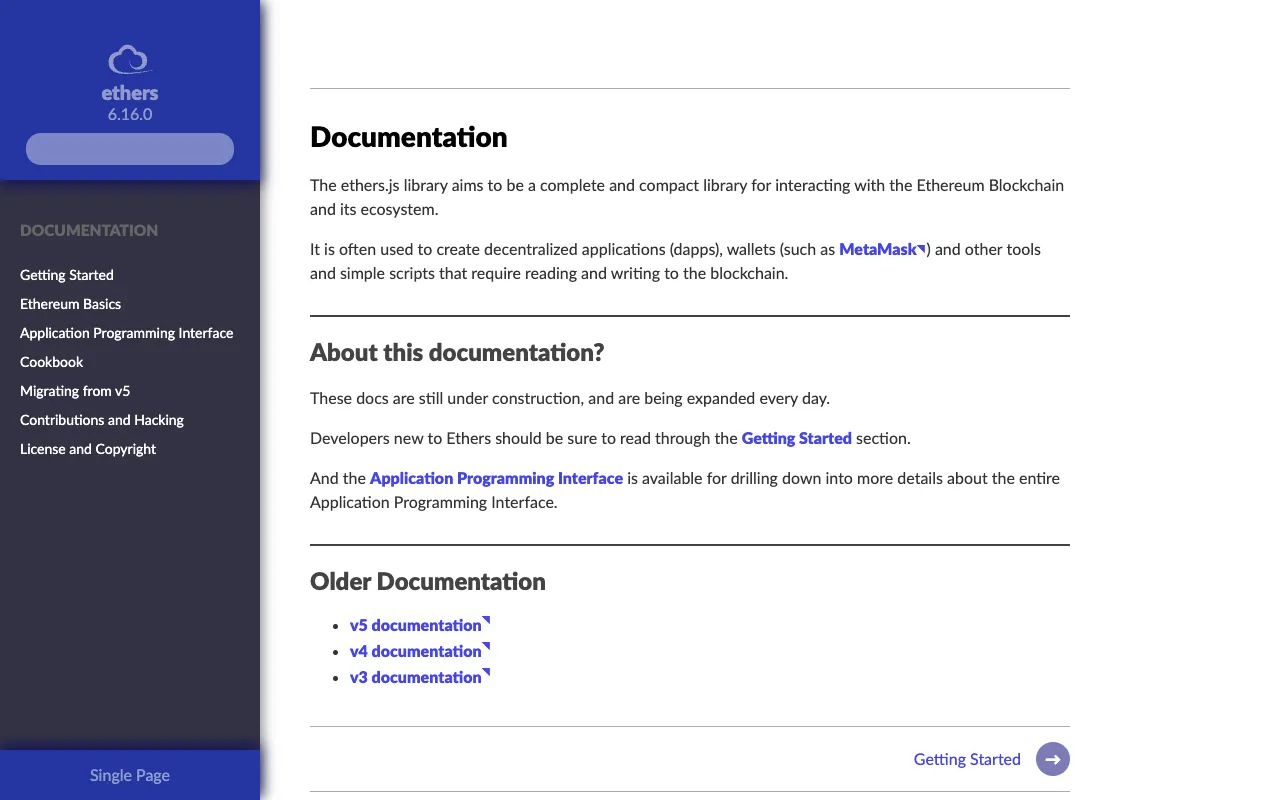
ethers.js – The Essential Ethereum Library for Blockchain Developers
ethers.js is the definitive JavaScript and TypeScript library for Ethereum development. Engineered for reliability and performance, it provides developers with a comprehensive toolkit to interact with the Ethereum blockchain, deploy and interact with smart contracts, manage wallets, and build sophisticated decentralized applications (dApps). Its compact size, extensive testing, and intuitive API make it the top choice for both beginners and seasoned Web3 developers.
What is ethers.js?
ethers.js is a robust, open-source library that serves as the bridge between your JavaScript/TypeScript application and the Ethereum network. It abstracts the complexities of direct RPC calls, offering a clean, promise-based interface for core blockchain operations. From querying blockchain data and sending transactions to deploying complex smart contracts and handling cryptographic signatures, ethers.js provides a complete, well-documented, and battle-tested solution for the entire Ethereum development lifecycle.
Key Features of ethers.js
Complete Ethereum Wallet Management
Securely create, import, and manage Ethereum wallets (both HD and non-HD). The library handles private keys, mnemonics, and JSON wallets with built-in best practices for security, making user onboarding and transaction signing straightforward and safe.
Smart Contract Interaction Made Simple
Deploy and interact with smart contracts using clean, typed ABIs. Ethers.js automatically parses contract ABIs to generate easy-to-use JavaScript objects, allowing you to call functions, send transactions, and listen for events with minimal boilerplate code.
Provider Abstraction for Any Network
Connect to Ethereum via JSON-RPC providers (like Infura, Alchemy, or a local node), Etherscan, or custom backends. This flexible architecture lets you seamlessly switch between Mainnet, testnets (Goerli, Sepolia), and local development environments.
First-Class TypeScript Support
Built with TypeScript from the ground up, ethers.js offers excellent type safety and auto-completion. This dramatically improves developer experience, reduces runtime errors, and accelerates the development of complex dApps.
Compact and Zero-Dependency
Designed with efficiency in mind, ethers.js is a single, minimal library with no external dependencies. This results in a smaller bundle size for front-end dApps, faster load times, and reduced attack surface compared to bulkier alternatives.
Who Should Use ethers.js?
ethers.js is indispensable for any developer building on Ethereum. Front-end developers use it to power dApp user interfaces that interact with smart contracts. Full-stack and back-end developers leverage it for blockchain indexing services, automated bots, and deployment scripts. Smart contract engineers rely on it for testing and deployment automation. Whether you're building a new DeFi protocol, an NFT marketplace, a DAO tool, or simply learning Web3 development, ethers.js provides the foundational tools you need.
ethers.js Pricing and Free Tier
ethers.js is a 100% free and open-source library released under the MIT License. There is no pricing, subscription, or paid tier. Developers can use its full feature set—including wallet management, contract interaction, and provider utilities—for commercial and personal projects without any cost or usage restrictions. The project is maintained by its creator and the open-source community.
Common Use Cases
- Building a decentralized finance (DeFi) application front-end that interacts with lending protocols
- Creating an NFT minting website that connects user wallets and calls smart contract mint functions
- Developing a blockchain data dashboard that fetches real-time transaction history and token balances
- Writing automated scripts to deploy and verify smart contracts across multiple Ethereum testnets
Key Benefits
- Accelerate development cycles with a stable, well-documented API that reduces integration time and bugs
- Enhance dApp security by using a library with a proven track record and secure handling of sensitive operations like private key management
- Improve application performance and user experience due to the library's small bundle size and efficient design
Pros & Cons
Pros
- Extremely reliable and extensively tested, making it a low-risk choice for production dApps
- Superior developer experience with excellent documentation, TypeScript support, and intuitive abstractions
- Actively maintained with a clear roadmap and responsive to ecosystem changes like The Merge and new EIPs
Cons
- Primarily focused on Ethereum and EVM-compatible chains, offering less native support for non-EVM blockchains
- The modular architecture and breadth of features can have a learning curve for absolute beginners in Web3
Frequently Asked Questions
Is ethers.js free to use?
Yes, ethers.js is completely free and open-source. It is released under the permissive MIT License, allowing unrestricted use in personal, commercial, and enterprise projects without any fees.
Is ethers.js good for Ethereum blockchain development?
Absolutely. ethers.js is considered one of the best and most reliable libraries for Ethereum development. Its comprehensive feature set for wallet management, contract interaction, and provider handling, combined with its stability and excellent documentation, makes it the go-to choice for a vast majority of professional Web3 developers and projects.
What is the difference between ethers.js and web3.js?
While both are popular Ethereum libraries, ethers.js is often preferred for its smaller bundle size, cleaner API design, and stronger focus on security (e.g., clearer separation of concerns between providers and signers). Web3.js has a larger ecosystem of plugins. Many developers find ethers.js more modular and easier to learn and use, especially for new projects.
Can I use ethers.js with other EVM blockchains?
Yes. ethers.js works seamlessly with any Ethereum Virtual Machine (EVM) compatible blockchain, such as Polygon, Arbitrum, Optimism, Avalanche C-Chain, and Binance Smart Chain. You simply need to connect to the correct RPC provider endpoint for your target network.
Conclusion
For developers serious about building on Ethereum, ethers.js is not just a library—it's a foundational tool. Its unparalleled combination of reliability, comprehensive features, and developer-friendly design solidifies its position as the industry standard. Whether you're launching a startup's MVP or maintaining a large-scale DeFi application, choosing ethers.js means building on a stable, secure, and well-supported foundation that will scale with your project's needs. Start integrating it today to experience faster, safer, and more efficient blockchain development.