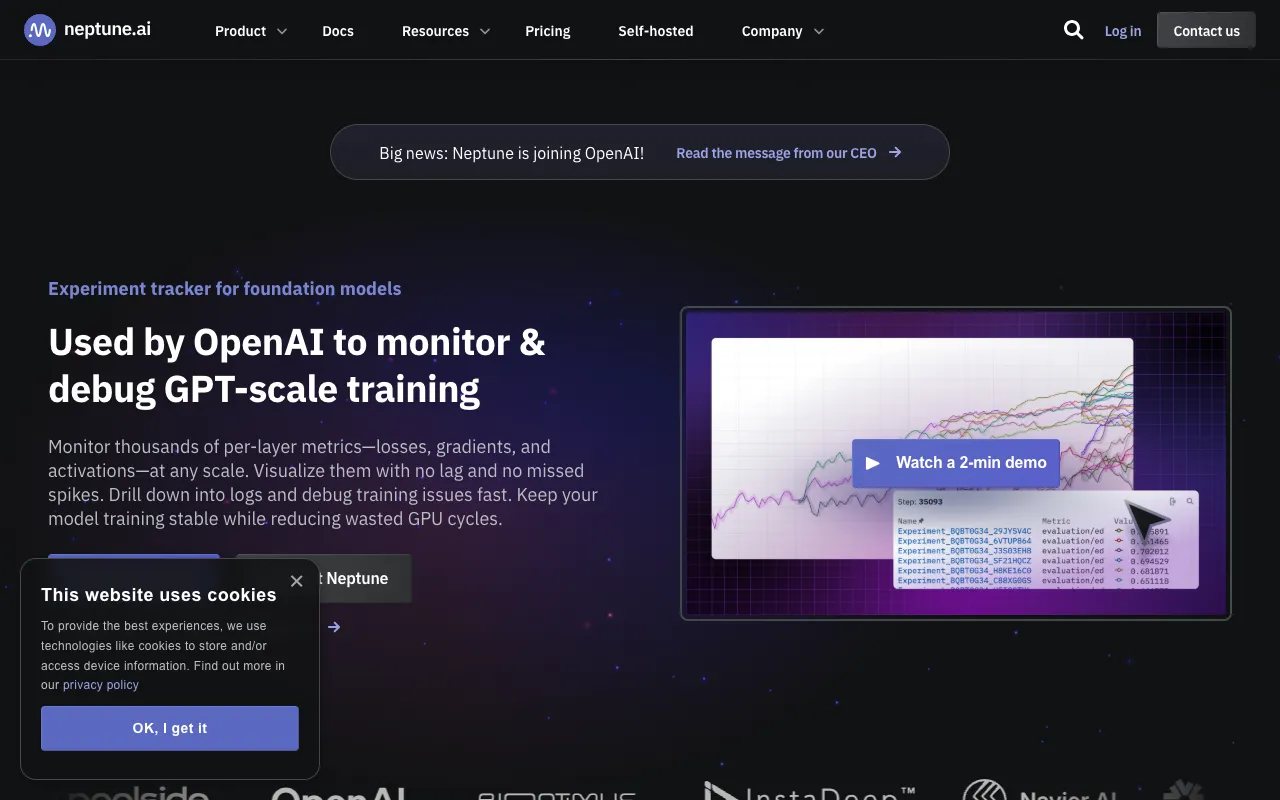
Neptune.ai – The Essential Metadata Store for AI Research & MLOps
Neptune.ai is the centralized metadata store built for AI researchers and ML teams who need to track, compare, and reproduce thousands of experiments. It transforms chaotic model development into a structured, collaborative process, enabling faster iteration and more reliable results from research to production. If your team struggles with experiment sprawl, lost parameters, or unreproducible results, Neptune.ai provides the single source of truth for your entire MLOps lifecycle.
What is Neptune.ai?
Neptune.ai is a specialized MLOps platform that functions as a centralized metadata store for machine learning experiments. It's designed specifically for teams—from academic research labs to enterprise production groups—that run a high volume of AI/ML experiments and need to maintain rigorous oversight. Unlike generic logging tools, Neptune.ai understands the unique structure of ML workflows, capturing everything from hyperparameters, code versions, and datasets to performance metrics, visualizations, and model artifacts. This creates a complete, queryable history of your team's work, making it possible to compare runs, identify winning approaches, and ensure full reproducibility.
Key Features of Neptune.ai
Centralized Experiment Tracking
Log everything in one place: metrics, hyperparameters, learning curves, images, model files, and console logs. Neptune.ai provides a unified dashboard to view and compare all experiments across your team, eliminating the need to juggle spreadsheets, local files, or disparate tools.
Powerful Comparison & Visualization
Side-by-side comparison tables and interactive charts allow you to pinpoint what drives model performance. Filter and sort experiments by any logged parameter or metric to quickly identify the best-performing models and the conditions that created them.
Reproducibility & Audit Trail
Neptune.ai automatically tracks code state (via Git), environment details, and dataset versions alongside your experiment runs. This creates an immutable audit trail, guaranteeing that any successful experiment can be perfectly reproduced or audited for compliance, a critical need in both research and regulated industries.
Collaboration for Teams
Share experiments, dashboards, and findings seamlessly with your team. Assign tags, add comments, and organize work into projects. Neptune.ai breaks down silos between researchers, engineers, and stakeholders, aligning everyone on model progress and results.
Integrations with Your ML Stack
Works seamlessly with your existing tools. Neptune.ai offers native integrations and client libraries for all major frameworks like PyTorch, TensorFlow, Keras, scikit-learn, and XGBoost, as well as orchestration tools like Kubeflow and MLflow.
Who Should Use Neptune.ai?
Neptune.ai is ideal for any team or individual where rigorous experiment management is a bottleneck to progress. Primary users include: **AI Research Scientists & PhDs** in academia or industry labs running hundreds of comparative studies; **ML Engineers** building production models who need traceability from research to deployment; **Data Science Teams** in startups and enterprises aiming to standardize their MLOps practices; and **Tech Leads & Managers** who need visibility into their team's model development process and require governance and reproducibility guarantees.
Neptune.ai Pricing and Free Tier
Neptune.ai offers a generous free tier perfect for individual researchers, small teams, or those evaluating the platform. The free plan includes core experiment tracking features with limited monthly usage, which is often sufficient for personal projects or small-scale research. For teams requiring higher volume, advanced features, and enterprise-grade security and support, Neptune.ai provides paid plans (Team, Business, Enterprise) billed per user per month. These scale to support unlimited experiments, advanced collaboration tools, on-premises deployment, and custom SLAs.
Common Use Cases
- Hyperparameter optimization tracking for deep learning models
- Managing and reproducing academic AI research papers
- Governance and compliance for ML models in regulated industries (Finance, Healthcare)
- Comparing model performance across different datasets and frameworks
- Onboarding new team members onto existing ML projects with full context
Key Benefits
- Accelerate model development by reducing time spent searching for past results and configurations.
- Improve model quality and reliability through systematic comparison and reproducible workflows.
- Enhance team collaboration and knowledge sharing with a centralized system of record.
- Mitigate risk in production deployments with a complete audit trail for every model.
- Scale your MLOps practice efficiently as your team and number of experiments grow.
Pros & Cons
Pros
- Purpose-built for ML experiment tracking with deep framework integrations.
- Superior UI/UX for comparing complex experiments side-by-side.
- Strong focus on reproducibility, capturing code, environment, and data state.
- Effective collaboration features designed for research and engineering teams.
- Generous free tier for individuals and small teams to get started.
Cons
- Can have a learning curve for teams entirely new to structured MLOps practices.
- Advanced enterprise features and higher usage limits require a paid plan.
- Primarily focused on experiment tracking and metadata, not full model deployment or serving.
Frequently Asked Questions
Is Neptune.ai free to use?
Yes, Neptune.ai offers a free tier that includes core experiment tracking features with limited monthly usage. This is an excellent way for individual researchers, students, or small teams to start managing their ML experiments at no cost.
Is Neptune.ai good for AI research?
Absolutely. Neptune.ai is one of the top-rated tools for AI research. It addresses the core challenges researchers face: tracking countless experiments, comparing results fairly, and ensuring studies are reproducible—a fundamental requirement for publishing credible research. Its flexibility and depth make it suitable for everything from exploratory academic research to large-scale industrial R&D.
How does Neptune.ai compare to TensorBoard or MLflow?
TensorBoard is a great visualization tool primarily for TensorFlow, while MLflow is a broader open-source MLOps platform. Neptune.ai often serves as a more powerful, user-friendly, and team-oriented alternative or complement. It offers a superior UI for comparison, stronger reproducibility features, and is built as a collaborative, hosted service, reducing infrastructure management overhead for teams.
What kind of metadata can I track with Neptune.ai?
You can track virtually any aspect of your experiment: hyperparameters, metrics (loss, accuracy, custom), learning curves, images/figures, model weights/artifacts, interactive visualizations, console logs, system hardware metrics (GPU/CPU usage), and links to dataset versions and code commits. This holistic view is key to understanding model behavior.
Conclusion
For AI research teams and ML engineers drowning in experiment sprawl, Neptune.ai is not just another tool—it's the foundational layer for organized, reproducible, and collaborative model development. It expertly fills the gap between writing training scripts and having a trustworthy, queryable record of your work. By choosing Neptune.ai, you invest in a system that scales with your ambitions, turning chaotic experimentation into a structured discovery process. Whether you're a solo researcher validating a novel architecture or an enterprise team deploying models to millions, Neptune.ai provides the clarity and control needed to build better AI, faster.