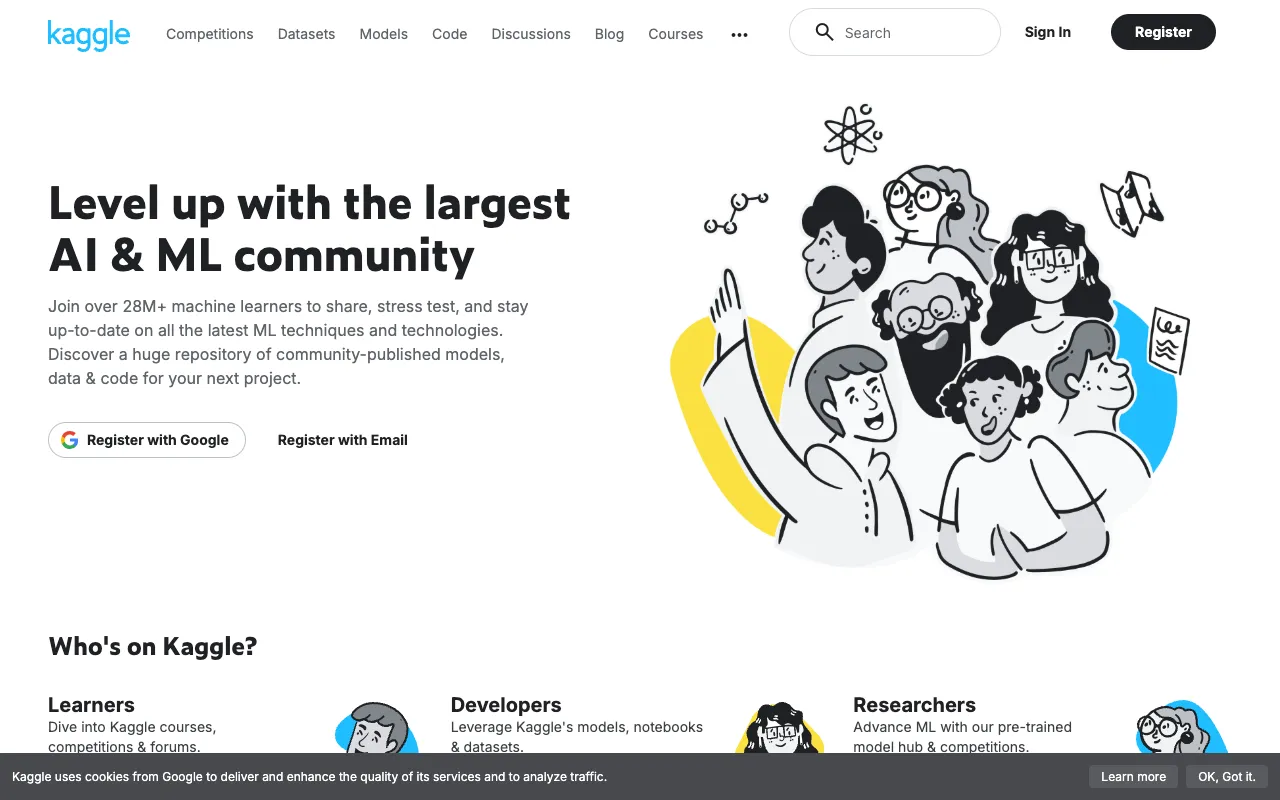
Kaggle – The Essential Platform for AI Researchers & Data Scientists
Kaggle is the world's largest data science and machine learning community, providing a unified environment where AI researchers can learn, collaborate, and compete. It uniquely combines free computational resources (including GPUs), a vast repository of datasets, interactive coding notebooks (Kaggle Notebooks), and real-world competitions sponsored by leading companies. For anyone from a student exploring machine learning to a professional researcher prototyping models, Kaggle eliminates infrastructure barriers and fosters practical, hands-on learning within a global network of peers.
What is Kaggle?
Kaggle is an online platform owned by Google that serves as a hub for the data science and machine learning ecosystem. It goes beyond a simple tool repository by integrating four core pillars: a collaborative coding environment (Notebooks), a massive library of curated datasets, competitive machine learning challenges with real prizes, and a vibrant community forum. This integrated approach makes Kaggle not just a tool, but a complete ecosystem for developing, testing, and showcasing AI research and practical data science skills. It's designed to democratize AI by providing free access to resources typically reserved for well-funded labs or corporations.
Key Features of Kaggle
Free Cloud GPU & TPU Compute
Kaggle Notebooks provide free, session-based access to NVIDIA GPU and Google TPU accelerators. This is a game-changer for researchers and students without access to expensive hardware, allowing them to train complex neural networks, run large-scale data processing, and experiment with state-of-the-art models directly in their browser, with no setup or cost.
Massive Dataset Repository
Hosting over 50,000 public datasets, Kaggle is one of the largest open data libraries. Researchers can find data for virtually any domain—from medical imaging and satellite data to financial time series and natural language corpora. This accelerates the data acquisition phase of research and provides benchmark data for model validation.
Machine Learning Competitions
Kaggle competitions, sponsored by organizations like Google, NASA, and research institutions, present real-world problems with significant prizes. Participating allows researchers to test their skills against global benchmarks, apply theory to practice, build a public portfolio, and potentially earn recognition and funding. Competitions often define the cutting edge of applied ML.
Collaborative Coding Notebooks
Based on Jupyter, Kaggle Notebooks support Python and R in a pre-configured, version-controlled environment. They facilitate seamless collaboration, allowing researchers to fork, modify, and share analyses. The integrated environment includes common ML libraries, making reproducibility and peer review straightforward.
Active Learning Community & Discussions
With millions of members, Kaggle's forums are a rich source of knowledge sharing. Researchers can get help on technical hurdles, discuss novel approaches in competition kernels, and learn from published solutions and tutorials. This collective intelligence accelerates problem-solving and learning.
Who Should Use Kaggle?
Kaggle is indispensable for a wide spectrum of users in the AI and data science field. Aspiring data scientists and ML engineers use it to build practical portfolios and learn from real-world projects. Academic researchers and students leverage the free compute and datasets for prototyping and supplementary analysis. Industry professionals participate in competitions to solve business challenges and scout for talent. Even experienced practitioners use Kaggle to stay sharp, benchmark new techniques, and engage with the community's latest innovations. It's the central platform for anyone looking to move from theoretical knowledge to applied, community-validated machine learning expertise.
Kaggle Pricing and Free Tier
Kaggle's core platform is completely free. There is no paid tier for accessing datasets, competitions, notebooks, community features, or the generous free GPU/TPU compute allowances. This commitment to a free tier is fundamental to its mission of democratizing data science. The platform is sustained by its value to Google Cloud and the sponsors of its competitions. Users only need a Google account to sign up and immediately access all resources, with no credit card required, making it the most accessible high-value platform in the AI research toolkit.
Common Use Cases
- Building a machine learning portfolio with real project experience
- Finding and analyzing free, high-quality datasets for academic research
- Practicing deep learning and neural network training with free GPU access
- Competing in data science challenges to solve real-world industry problems
- Learning data science through collaborative notebooks and community tutorials
Key Benefits
- Eliminates hardware cost barriers with free, cloud-based GPU and TPU compute
- Accelerates learning and skill validation through hands-on competition and peer review
- Provides a centralized hub for data, code, and community, streamlining the research workflow
- Enables researchers to benchmark their work against global standards and state-of-the-art solutions
- Offers a powerful platform to build a public reputation and portfolio recognized by employers
Pros & Cons
Pros
- Unmatched free access to computational resources (GPU/TPU) for model training
- Vast, curated repository of datasets across numerous domains and industries
- Direct pathway to practical experience and portfolio building via real-world competitions
- Highly active and supportive global community for collaboration and troubleshooting
- Fully browser-based, eliminating local environment setup and configuration headaches
Cons
- Compute sessions have time limits and may require reconnection for very long training jobs
- The competitive environment can sometimes emphasize leaderboard optimization over generalizable research practices
- As a Google product, it is tied to a Google account and ecosystem
Frequently Asked Questions
Is Kaggle free to use?
Yes, Kaggle is completely free. You can sign up with a Google account and immediately access all its core features: datasets, competitions, notebooks, community discussions, and the free tier of GPU and TPU compute. There are no subscription fees or hidden costs.
Is Kaggle good for AI researchers and data scientists?
Absolutely. Kaggle is arguably the best platform for AI researchers and data scientists seeking practical, hands-on experience. It uniquely combines the essential resources—data, compute, and community—needed to go from theory to application. It's invaluable for prototyping, benchmarking, learning new techniques, and building a public portfolio of work.
How much free GPU time do you get on Kaggle?
Kaggle offers generous but session-limited free GPU and TPU access. Typically, notebook sessions can run for up to 9-12 hours continuously on accelerator resources. If your training requires more time, you can save checkpoints and resume in a new session. This is more than sufficient for most experimentation, prototyping, and competition submissions.
Can you get a job from using Kaggle?
Yes, many data scientists have secured jobs directly through Kaggle. A strong competition ranking (like achieving the title of 'Kaggle Grandmaster') is highly respected in the industry. Furthermore, the public notebooks and datasets you contribute serve as a tangible portfolio that demonstrates your skills to potential employers, often more effectively than a traditional resume alone.
Conclusion
For AI researchers, machine learning engineers, and data scientists at any level, Kaggle is not just another tool—it's a foundational ecosystem. It successfully bridges the gap between academic learning and industrial application by providing the critical triad of data, compute, and community at zero cost. Whether you're exploring a new ML library, searching for a benchmark dataset, competing for a prize, or collaborating on an analysis, Kaggle should be your first stop. Its unparalleled free resources and global network make it the single most valuable and accessible platform for advancing practical AI research and building a recognized career in the field.