Connected Papers – The Best Visual Tool for AI Research Discovery
Connected Papers revolutionizes academic literature review by transforming static citation lists into dynamic, interactive visual graphs. Designed specifically for researchers in fast-moving fields like Artificial Intelligence and Machine Learning, this tool helps you visually explore the connections between scholarly papers. Start with one seed paper and instantly discover related work, identify foundational literature, and map the intellectual landscape of any research topic—all within an intuitive, graph-based interface that makes complex citation networks understandable at a glance.
What is Connected Papers?
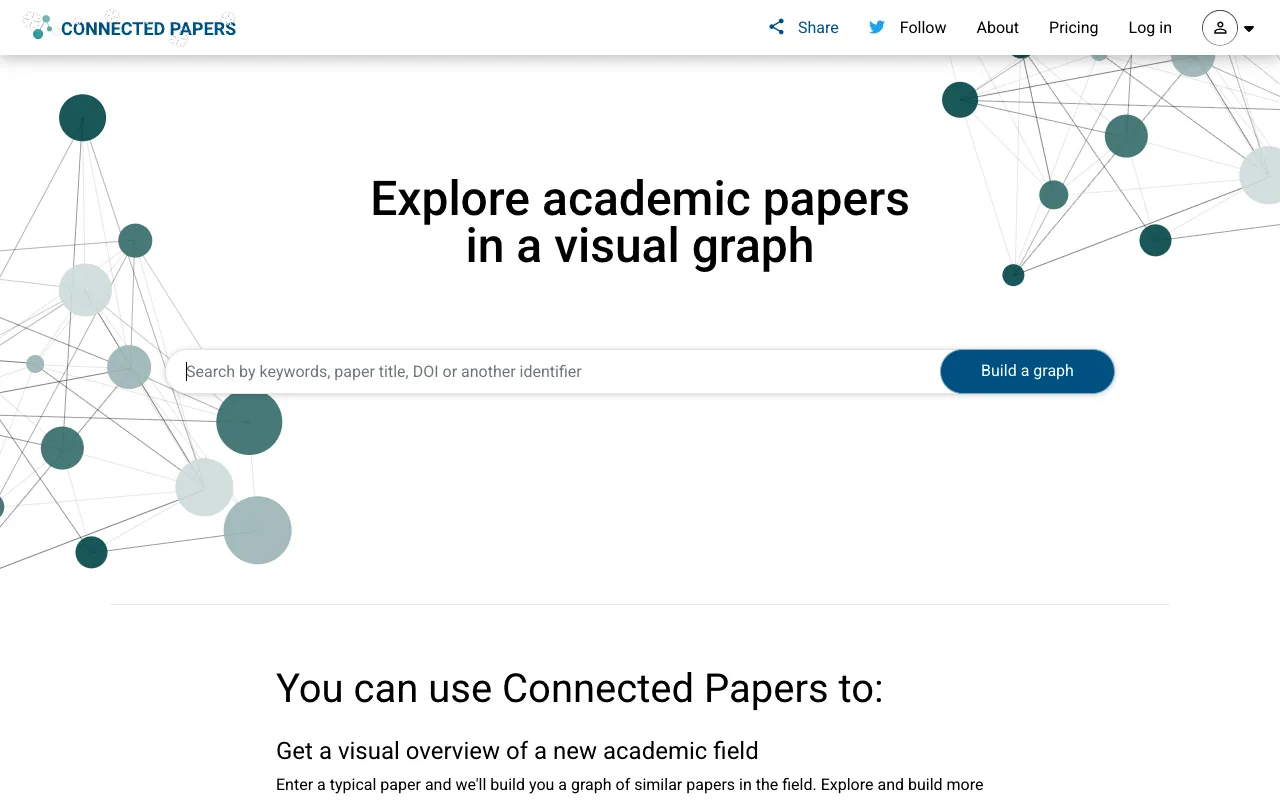
Connected Papers is a specialized web application that generates visual graphs representing the relationships between academic papers. Instead of manually tracing citations through linear lists, researchers input a single 'seed' paper (via DOI, arXiv ID, title, etc.), and the tool automatically builds an interactive network diagram. Each node represents a paper, with lines connecting papers that reference each other. The visualization highlights papers that are most connected within the network, helping you quickly identify seminal works, review articles, and recent developments. It's particularly powerful for AI researchers who need to stay current with rapidly evolving subfields like large language models, computer vision, or reinforcement learning.
Key Features of Connected Papers
Interactive Visual Graph Explorer
The core feature is a force-directed graph where you can click, drag, and zoom to explore connections. Node size and position are algorithmically determined by connectivity and relevance, putting the most important papers at the center. This spatial representation provides immediate insight into a research field's structure that text-based searches cannot match.
Prior Works & Derivative Works Panels
Beyond the main graph, Connected Papers provides two crucial lists: 'Prior Works' (key papers that inspired the seed paper's field) and 'Derivative Works' (important subsequent research that builds upon it). This temporal context helps you understand the lineage and impact of research, perfect for writing literature reviews or grant proposals.
Smart Paper Recommendations & Discovery
The tool's algorithm doesn't just show direct citations. It analyzes the semantic content and bibliographic coupling to surface papers that are conceptually related, even if they don't directly cite each other. This leads to serendipitous discoveries and helps researchers find relevant work outside their immediate citation bubble.
Extensive Database & Export Options
Connected Papers pulls data from Semantic Scholar, a comprehensive database ideal for AI/CS research. You can export your graph as an image for presentations or share a unique URL with collaborators. The tool also provides quick links to paper abstracts on arXiv, PubMed, and publisher sites.
Who Should Use Connected Papers?
Connected Papers is indispensable for anyone conducting literature-intensive research. It's perfect for AI and Machine Learning PhD students starting a new dissertation topic, postdocs surveying a field for the first time, professors writing grant proposals or review articles, and industry researchers in tech R&D labs needing to quickly get up to speed on a technical area. It's also valuable for research librarians, science journalists, and venture capitalists who need to assess technological landscapes. If your work involves understanding 'what papers are important here and how are they connected,' this tool will save you dozens of hours.
Connected Papers Pricing and Free Tier
Connected Papers operates on a generous freemium model. The free tier allows any user to generate graphs without creating an account, with a limit of a few graphs per month—perfect for occasional or exploratory use. For power users like active researchers, graduate students, or labs, paid Pro plans offer unlimited graphs, priority queue access for faster processing, and the ability to save and organize your graphs privately. This pricing structure makes advanced literature discovery accessible to everyone while supporting the tool's ongoing development.
Common Use Cases
- Starting a new AI research project and needing to identify the 20 most important foundational papers quickly
- Writing the 'Related Work' section for a machine learning conference paper or thesis literature review
- Preparing a survey talk or tutorial on a niche AI topic like diffusion models or neural symbolic reasoning
- Due diligence for AI startup investment by mapping the academic landscape around a specific technology
Key Benefits
- Accelerate literature review by visually identifying seminal papers and research trends in minutes instead of weeks
- Discover relevant AI research you would have missed using traditional keyword-based database searches alone
- Improve the quality and completeness of your 'Related Work' sections by understanding true paper connections
- Enhance research presentations and grant proposals with clear visual maps of the scholarly landscape
Pros & Cons
Pros
- Unique visual approach transforms abstract citation networks into intuitive, explorable maps
- Exceptionally useful for fast-moving fields like AI where new papers are published daily
- Free tier provides substantial value for students and researchers with limited budgets
- Clean, user-friendly interface requires no technical expertise to start gaining insights
- Powerful for discovering the intellectual structure of a field, not just individual papers
Cons
- Graph generation can be slow during peak academic periods (e.g., before conference deadlines)
- Limited to papers in the Semantic Scholar database, though coverage for AI/CS is excellent
- Visualization is less helpful for extremely niche topics with very few connected papers
- Free users have a monthly graph limit, which may constrain very active research projects
Frequently Asked Questions
Is Connected Papers free to use?
Yes, Connected Papers offers a robust free tier that allows you to generate several graphs per month without creating an account. This is sufficient for many students and occasional researchers. For unlimited graphs and priority processing, paid Pro plans are available.
Is Connected Papers good for AI and Machine Learning research?
Absolutely. Connected Papers is particularly powerful for AI/ML research due to its integration with Semantic Scholar, which has excellent coverage of computer science and AI venues like arXiv, NeurIPS, ICML, and ACL. The visual approach is ideal for navigating the dense, rapidly evolving citation networks common in these fields.
How accurate is the Connected Papers graph?
The graphs are highly accurate for showing bibliographic connections, as they are built from real citation data. The algorithm also incorporates semantic similarity, which can surface thematically related papers that don't cite each other directly. It's a powerful tool for exploration, but researchers should still verify critical citations manually for formal publications.
Can I use Connected Papers for systematic literature reviews?
Connected Papers is an excellent starting point for systematic reviews, especially the 'snowballing' phase where you use key papers to find more. It helps ensure you haven't missed seminal works. However, it should complement, not replace, formal database searches and protocol-driven review methods for rigorous systematic reviews.
Conclusion
Connected Papers fills a unique and critical gap in the AI researcher's toolkit. By making the implicit connections in academic literature explicit and visual, it transforms a tedious, linear process into an engaging, efficient discovery journey. For anyone conducting literature reviews, exploring new research domains, or needing to quickly grasp the structure of a scholarly conversation, it delivers immense value. Its thoughtful freemium model ensures accessibility, while its focused functionality on research discovery—without attempting to be yet another reference manager—makes it a best-in-class solution. If your work involves understanding what's been published and how ideas connect in AI, Connected Papers is an essential tool that will save you time and improve the depth of your research.